Table of content


This Energy Converter lets you switch between common energy units in seconds. Convert joules, kWh, BTU, calories, electronvolts, and other units accurately with a simple input. Ideal for study, engineering tasks, electricity usage checks, or quick everyday conversions.
Using this Energy Converter takes only a few seconds. The interface is designed to keep everything simple, so you can focus on getting the result without distractions.
Step 1: Enter your energy value
Type the number you want to convert into the input box. You can enter whole numbers or decimals, depending on your calculation needs.
Step 2: Select the original unit
Choose the unit that your value is currently measured in. This could be joules (J), kilowatt-hours (kWh), calories (cal), BTU, electronvolts (eV), or another available option.
Step 3: Choose the target unit
Select the unit you want to convert to. The tool will automatically apply the correct conversion factor based on your selection.
Step 4: Click “Convert”
Press the convert button to generate your result instantly. There’s no waiting time — calculations are processed immediately.
Step 5: Review your result
The converted value will appear clearly on the screen. If needed, you can adjust the input or switch units to perform another calculation right away.
That’s it. No complex setup, no extra configuration — just enter, select, and get your energy conversion instantly.
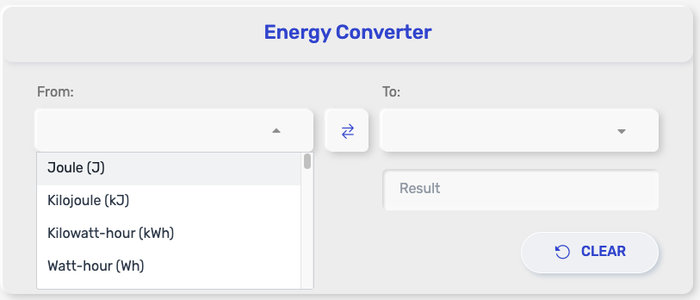
This Energy Converter supports a wide range of commonly used energy units across physics, electricity, heating, engineering, and science. You can quickly switch between small-scale laboratory measurements and large industrial energy values without needing separate tools.
Below are the main unit categories available:
These are standard scientific units used worldwide:
Joule (J) – The base SI unit of energy
Kilojoule (kJ) – 1 kJ = 1000 J
Megajoule (MJ) – 1 MJ = 10⁶ J
Gigajoule (GJ) – 1 GJ = 10⁹ J
Joule-based units are widely used in physics, engineering, and technical documentation.
These are commonly used for electricity generation and billing:
Watt-hour (Wh)
Kilowatt-hour (kWh) – Standard unit on electricity bills
Megawatt-hour (MWh)
For example: 1 kWh = 3.6 × 10⁶ J
These units are ideal when calculating appliance energy use or estimating power consumption.
Used in heating systems, thermodynamics, and food energy calculations:
Calorie (cal)
Kilocalorie (kcal)
British Thermal Unit (BTU)
Common conversions include:
1 cal = 4.184 J
1 kcal = 4184 J
1 BTU ≈ 1055 J
Nutrition labels typically use kilocalories (kcal), while HVAC systems often use BTU.
For extremely small energy values: Electronvolt (eV)
Conversion reference: 1 eV = 1.602 × 10⁻¹⁹ J
Electronvolts are commonly used in atomic physics and semiconductor research.
Additional units frequently used in engineering fields:
Foot-pound (ft·lb)
Therm
Erg
These units appear in mechanical calculations, gas energy measurement, and older scientific literature.
With all these units supported in one place, you can convert from large-scale power production to microscopic particle energy in seconds — without switching between multiple calculators.
The result displayed by the Energy Converter shows the equivalent value of your input in the unit you selected. It reflects a direct mathematical conversion based on fixed international energy conversion constants.
When you enter a value and choose two units, the tool applies the correct conversion factor automatically. The number you see is the same amount of energy, simply expressed in a different measurement system.
For example:
If you convert 1 kilowatt-hour (kWh) to joules, the result will be:1 kWh = 3.6 × 10⁶ J
This means one kilowatt-hour equals 3,600,000 joules of energy.
If you convert 500 calories (cal) to joules, the result will reflect:1 cal = 4.184 J
So the output represents the same energy quantity measured in SI units.
The converted value allows you to:
Compare different forms of energy on the same scale
Estimate electricity consumption in joules or kWh
Convert food energy into scientific units
Match heating system ratings (BTU to kWh or joules)
Use consistent units in engineering or academic calculations
Large numbers may appear in scientific notation (for example, 3.6 × 10⁶) to keep the result clean and readable.
Very small values may also be shown in exponential format.
Decimal rounding depends on display settings, but the internal calculation maintains precision.
In short, the result tells you how much energy your original value represents in another unit system — without changing the actual amount of energy itself.
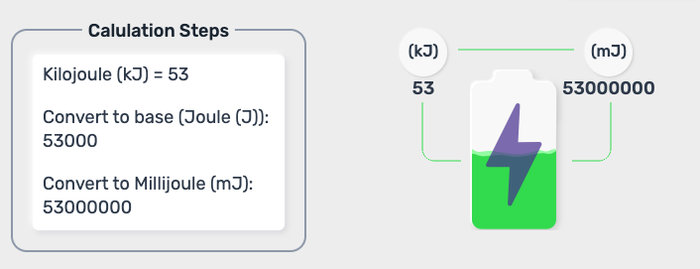
Below are the standard energy conversion formulas used by this Energy Converter. Each value is based on internationally accepted constants. These relationships allow you to convert between SI units, electrical energy units, thermal units, and mechanical units accurately.
1 J = 1 N·m
(Joule is the standard SI unit of energy.)
1 J = 1,000 mJ1 J = 0.001 kJ1 J = 2.7778 × 10⁻⁷ kWh1 J = 0.00027778 Wh1 J = 0.239005736 cal1 J = 0.000239006 kcal1 J ≈ 0.000947817 BTU1 J ≈ 0.737562 ft·lb1 J = 6.241509 × 10¹⁸ eV1 J ≈ 9.47817 × 10⁻⁹ therm
1 kJ = 1,000 J1 kJ = 0.277778 Wh1 kJ = 0.000277778 kWh1 kJ ≈ 239.006 cal1 kJ ≈ 0.239006 kcal1 kJ ≈ 0.947817 BTU
1 kWh = 3.6 × 10⁶ J1 kWh = 3,600 kJ1 kWh = 1,000 Wh1 kWh ≈ 860,420.65 cal1 kWh ≈ 860.421 kcal1 kWh ≈ 3,412.142 BTU1 kWh ≈ 2.655 × 10⁶ ft·lb1 kWh ≈ 0.0341214 therm
1 Wh = 3,600 J1 Wh = 3.6 kJ1 Wh = 0.001 kWh1 Wh ≈ 859.845 cal1 Wh ≈ 0.859845 kcal1 Wh ≈ 3.412142 BTU
1 cal = 4.184 J1 cal = 0.004184 kJ1 cal = 1,000 mcal1 cal ≈ 3.96832 × 10⁻⁶ kWh1 cal ≈ 0.00396567 BTU
1 kcal = 1,000 cal1 kcal = 4,184 J1 kcal = 4.184 kJ1 kcal ≈ 0.00116222 kWh1 kcal ≈ 3.96567 BTU
1 BTU ≈ 1,055.06 J1 BTU ≈ 1.05506 kJ1 BTU ≈ 0.000293071 kWh1 BTU ≈ 252.164 cal1 BTU ≈ 0.252164 kcal1 BTU ≈ 778.169 ft·lb1 BTU ≈ 0.00001 therm
1 eV = 1.602176634 × 10⁻¹⁹ J1 eV = 1.602176634 × 10⁻²² kJ1 eV ≈ 3.82929 × 10⁻²³ cal1 eV ≈ 2.77778 × 10⁻²⁶ kWh
1 ft·lb ≈ 1.35582 J1 ft·lb ≈ 0.00135582 kJ1 ft·lb ≈ 0.000376616 Wh1 ft·lb ≈ 0.00128507 BTU
1 therm = 100,000 BTU1 therm ≈ 1.05506 × 10⁸ J1 therm ≈ 29.3071 kWh
These formulas form the foundation of every calculation performed by the Energy Converter. Each conversion uses fixed constants, ensuring consistent and reliable results across different unit systems.
Accurate energy conversion keeps your numbers reliable when you switch between units like J, kWh, cal, or BTU. A small mistake can turn into a big problem—especially when the values are large, or when you’re comparing different systems.
Prevents calculation mistakes: One wrong conversion factor can throw off your whole result, even if your input was correct.
Ensures fair comparisons: It’s much easier to compare electricity, heat output, and mechanical work when everything is in the same unit.
Avoids cost estimation errors: If you’re estimating energy use for appliances, heating, or power bills, correct conversions keep your budget math on track.
Supports engineering precision: In technical work, units need to match. Accurate conversions reduce confusion and help keep designs and calculations consistent.
Keeps schoolwork consistent: For physics, chemistry, or engineering classes, correct unit conversion helps you arrive at the right answer and show clean, consistent steps.
In short: accurate conversions mean fewer surprises, cleaner calculations, and results you can trust.
International Bureau of Weights and Measures (BIPM) – The International System of Units (SI)
https://www.bipm.org/en/publications/si-brochure
National Institute of Standards and Technology (NIST) – SI Units and Energy Conversions
https://www.nist.gov/pml/weights-and-measures/si-units
NIST Physics Laboratory – CODATA Value for Electron Volt–Joule Relationship
https://physics.nist.gov/cgi-bin/cuu/Value?evj
U.S. Energy Information Administration (EIA) – Energy Units and Conversions
https://www.eia.gov/tools/faqs/faq.php?id=45&t=8
International Organization for Standardization (ISO) – Quantities and Units (ISO 80000 Series)
https://www.iso.org/standard/64973.html
Engineering Toolbox – Energy and Work Unit Conversions
https://www.engineeringtoolbox.com/energy-conversion-d_215.html
U.S. Department of Energy – Energy Basics
https://www.energy.gov/eere/education/energy-basics
British Thermal Unit (BTU) Definition – ASHRAE Handbook Fundamentals
https://www.ashrae.org/technical-resources/ashrae-handbook
Yes. The converter uses fixed international constants for every unit relationship. Each result is calculated using standardized values such as 1 kWh = 3.6 × 10⁶ J and 1 cal = 4.184 J, ensuring consistent and reliable conversions across all supported units.
The displayed result may round slightly depending on how many decimal places are shown. However, the internal calculation keeps full precision. Very large or very small values may appear in scientific notation, such as 3.6 × 10⁶.
Yes. The Energy Converter supports extremely large units like therms or kilowatt-hours, as well as very small units like electronvolts (eV). Scientific notation is used when necessary to keep numbers readable.
The joule (J) is the official SI unit of energy. Kilowatt-hour (kWh) is commonly used for electricity billing, BTU is widely used in heating systems, and kilocalorie (kcal) is standard for food energy measurement.
1 kcal = 1,000 cal
In food labeling, “Calorie” (with a capital C) usually refers to one kilocalorie. In scientific contexts, calorie (cal) refers to the smaller unit.
Energy values can become large when converting from bigger units to smaller ones. For example, 1 kWh = 3,600,000 J. The amount of energy remains the same; it is simply expressed in a smaller unit, which results in a larger numerical value.
Energy-converter.net was created to make energy unit conversions simple, fast, and accessible for everyone. Whether you're a student, engineer, researcher, or just someone needing a quick calculation, our tool helps you convert between various energy units quickly and accurately through a clean, easy-to-use interface.
Our goal is to provide a reliable one-page online converter that removes unnecessary complexity. By focusing on speed, accuracy, and simplicity, Energy-converter.net allows users to perform energy conversions instantly without downloads, registrations, or complicated steps.
This tool was built and maintained by a small team of developers and contributors who are passionate about creating practical online utilities. Their work focuses on building lightweight, reliable tools that help people solve everyday calculation needs quickly and efficiently.
We continue to improve Energy-converter.net to ensure it remains a helpful resource for anyone who needs quick and dependable energy unit conversions.
We are committed to providing reliable and easy-to-use conversion tools while maintaining transparency and respecting user privacy.
Energy-converter.net does not require account registration or personal information. Any values you enter for energy conversion are used only to perform calculations in real time and are not stored, tracked, or shared with third parties.
While Energy-converter.net uses widely accepted unit conversion formulas for energy measurements, the results are intended for informational and general calculation purposes only. For scientific, engineering, or professional applications where precision is critical, users should verify results using official references or professional tools.
By using Energy-converter.net, you agree to use the tool responsibly. The website and its contributors are not responsible for decisions, calculations, or outcomes based solely on the results provided by the converter.
We may update this Policy occasionally to reflect improvements to the tool or changes in regulations. Any updates will be published on this page to maintain transparency and keep users informed.